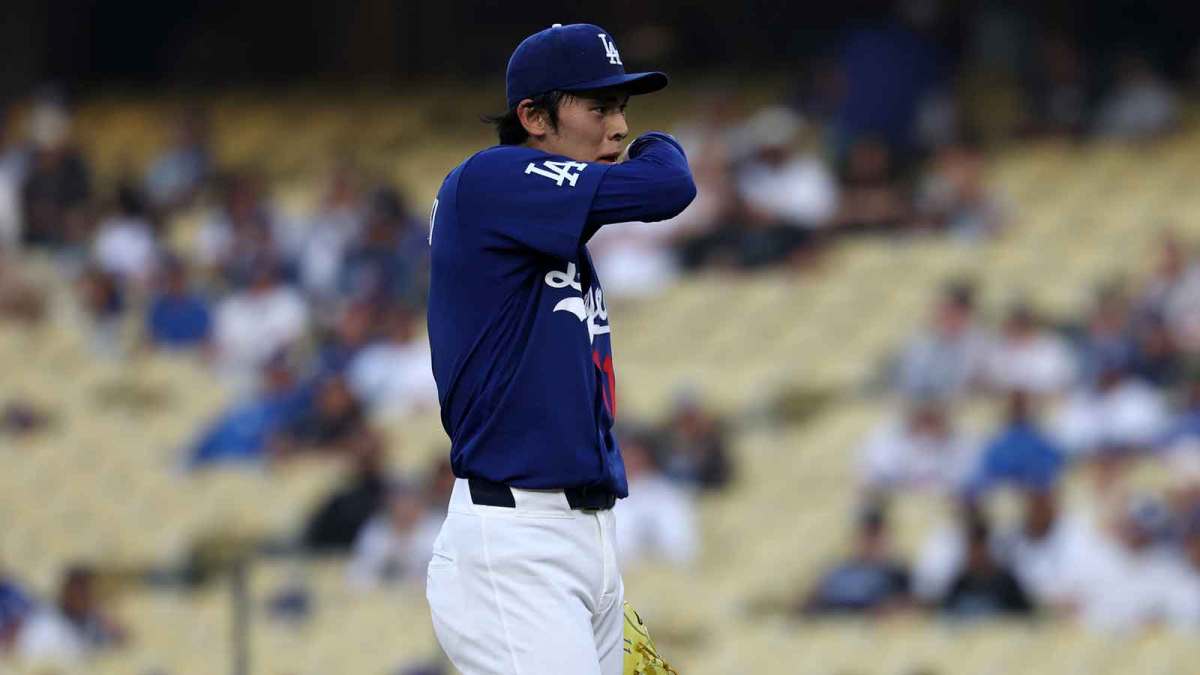
Los Angeles Dodgers starting pitcher Roki Sasaki had a rough spring training in 2026. He threw 8.2 innings across 4 games. During those innings, he allowed 9 hits and 15 walks, resulting in an earned run average of 15.58, giving up 15 runs.
His spring training performance is worrisome, echoing his struggles as a starter in 2025. In 8 starts, Sasaki threw 34.1 innings, allowing 22 walks and 29 hits. These led to a 4.72 ERA and 18 runs allowed.
Roki Sasaki’s performance has led the Los Angeles Dodgers to acknowledge that his spot in the rotation could be temporary during the 2026 season. On March 23rd, manager Dave Roberts told the media that Sasaki needs to perform to remain in the rotation all year.
“We’re going to run him out there. So for me to put my head in a space that there’s another alternative right now, that’s not helpful,” he said. “We’re going to support him as much as we can, and then give him some runway, and then, you know, once the season starts, then it’s about production”.
Given the Dodgers manager’s statements, how can Sasaki improve his statistics quickly to stay in the lineup? Well, the answer could be moving towards the first-base side of a rubber. Roki Sasaki currently pitches from the third-base side of the rubber. This is a major problem because his favorite pitch is the four-seam fastball.
Roki Sasaki’s fastball usage
In 10 appearances last year for the Los Angeles Dodgers, he threw 310 four-seam fastballs, accounting for 49.9% of his pitches. Roki’s four-seam fastball has 10.5 inches of arm-side movement, 3.7 inches above average.
You may be asking, “What does this mean?” Baseball experts usually use two terms to describe pitch movement: arm-side and glove-side. Arm-side movement refers to pitches that move toward the pitcher’s throwing hand.
On the other hand, glove-side movement is when pitches move away from the throwing arm toward the glove.
Roki has arm-side movement on his four-seam fastball, which means it naturally moves towards the right-handed batter’s box. This is a problem because Roki Sasaki is standing on the third-base side of the rubber, which is much closer to the right-handed batter’s box than the left one. Consequently, he is reducing the space he has to throw a ball into the strike zone.
In fact, he located 23.3% of his fastball on the right side of the plate, throwing 145 last season. It is 8.3% higher than the left side of the plate, as he only threw 93 fastballs on that side.
Furthermore, 69 fastballs he threw to the right side of the plate landed outside the strike zone, accounting for 11% of his total fastballs.
When he isn’t throwing the four-seam fastball , he relies on the split-finger fastball. He threw the pitch 208 times, which accounted for 33.5% of his pitches. Similar to the for steamer, the split finger also had arm-side movement of 1.1 inches.
The split finger fastball arm side movement is way below the league average by 7.6inches.
Given Roki Sasaki’s fastball usage and arm-side movement, I recommend he move to the first-base side of the rubber. Doing so will maximize his fastball’s effectiveness while maintaining control in the strike zone.
Leave a Reply